Solana Foundation Delegation Program: What the Data Actually Shows
Two narratives about the Solana Foundation Delegation Program have dominated the validator conversation over the past year. One says the program props up validators who could never survive without it. The other says the program is killing validators.
Both cannot be true at the same time.
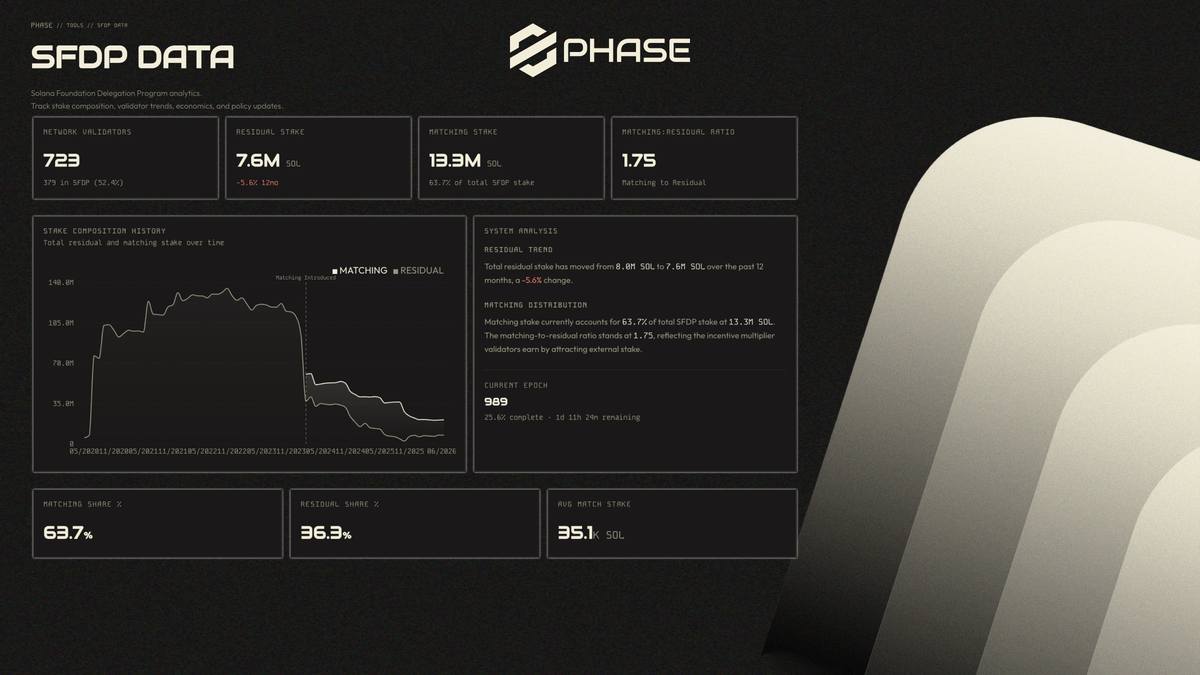
Phase built a public dashboard to track the SFDP's evolution over time. Here is what it shows.
What was the SFDP designed to do?
The Solana Foundation Delegation Program launched with two stated goals: enhance censorship resistance and grow the validator set.
The censorship resistance objective drove the program's core design. Rather than pile delegation onto validators that are already large, the program steers its stake toward smaller operators, it doesn't delegate to validators above roughly 1M SOL. The goal is to make it structurally harder for any small cluster of nodes to accumulate the stake required to compromise the network. The goal is to make it structurally harder for any small cluster of nodes to accumulate the stake required to compromise the network.
The second goal was economic: make validator operations viable for operators who could not yet attract enough external stake to cover costs. The program deployed up to 100 million SOL and rebalanced every four epochs as network conditions changed, automatically reinvesting staking yields back into the pool.
The graduation dynamic was a consequence of that design, not the original purpose. As validators built independent stake, Foundation support was intended to step down. Whether the execution matched that intent is a fair question, but understanding the original design matters for evaluating the data that follows.
Did the SFDP prop up the validator set?
In September 2024, Helius published a widely cited analysis built on mid-August data: 73 percent of SFDP participants had attracted less than 10,000 SOL in outside stake, and 51 percent had attracted less than 1,000.
The conclusion: if the program were discontinued immediately, roughly 897 validators, 57 percent of the entire validator set, would struggle to maintain profitable operations. The validator set was artificially inflated.
At the time, many validators were heavily dependent on stake received through the program.
But there is a critical problem with drawing structural conclusions from that data: it was a snapshot, not a trend. And the program has changed fundamentally since August 2024.
Is the SFDP killing validators?
By October 2025, the conversation had shifted. Validators were losing money, and operators in the community flagged some flipping to 100 percent commission to stay afloat, a move that breaks SFDP criteria and removes a validator from the program. The narrative became: the Solana Foundation is actively destroying the validator set.
Jacob Creech, VP of Technology at the Solana Foundation, offered a more nuanced take that gets overlooked.
In his words:
"Removing validators that are unable to attract stake and be beneficial to the network is a net positive. Gaining stake has huge incentives for any validator on the network. Competition should be high and those unable to make it should be removed."
The question is not whether validators are leaving the program. The question is whether the right validators are leaving.
What does the SFDP data actually show?
The SFDP has undergone four major policy changes since late 2023. Each one tightened requirements and accelerated the program's transition from static subsidy to earned support. As of June 2026, at epoch 989 , here is where the program stands.
The program has shrunk nearly 80 percent from its peak. SFDP validator count dropped from 1,893 at peak to 375 today, per the official delegation dashboard. This was not a sudden collapse. It was a phased reduction across four policy changes over two years.
Foundation stake is now 4 percent of the network. The program delegates 20.83 million SOL today, down from roughly 100 million at launch, and SFDP stake has fallen from 44.4 percent of all staked SOL in November 2020 to 4 percent now. The Foundation is committing far less capital to the program than it once did, and the network barely depends on it.
Residual stake per validator has collapsed from its early peak. In the program's first years the baseline allocation ran into the hundreds of thousands of SOL per validator; today it's about 20,000 SOL per validator.
Most SFDP stake is now earned, not handed out. When the Foundation overhauled the program in February 2024, introducing stake matching, it fundamentally redesigned how delegation works. Instead of distributing stake evenly, it matches what validators earn independently. Today, matching stake accounts for 63.7% of the program's stake, versus 36.3% residual.
Nearly half the validator set now operates outside the program. In August 2024, 72 percent of all Solana validators were in the SFDP. As of June 2026 it is 59 percent. The operators who remain outside it sustain themselves without program delegation. The network is less program-dependent than it has ever been.
Each policy change had measurable effects.
The revised program launched in February 2024: it introduced stake matching, cut the maximum commission from 10% to 7%, and raised block-production and vote-credit requirements.
In August 2024, the commission cap dropped again from 7% to 5% and MEV commission was capped at 10%, forcing out higher-commission operators.
In April 2025, the 3-to-1 onboarding/offboarding policy arrived: validators eligible for 18+ months with under 1,000 SOL of external stake were removed, and more than 600 were offboarded between April and December 2025.
In October 2025, the program took its incubator shape: matching dropped from a 1:1 ratio with a 100K SOL cap to 0.5:1 with a 50K cap, phased in over Epochs 865 to 893.
None of these changes were arbitrary. Each one moved the program further from permanent subsidy and closer to incubation. And the program's current design says so explicitly: vote costs are covered on a step-down schedule that ends after a validator's first year, matching is capped and earned, and the program still onboards 100 new testnet validators every month. That is the shape of an incubator, support that starts full, steps down on a schedule, and recycles toward the next cohort.
Validators who used it as a launchpad to build independent stake and external relationships are still operating today.
The data does not show a program failing, It shows a program doing what it was designed to do: evolve.
How the SFDP shaped Phase Delegation's design
This data informs how Phase thinks about delegation. Merit-based allocation only works if the incentive structure rewards active building.
The Index Power Score was designed with this principle at its center: contribution reviews, sustainability scoring, and a rolling evaluation window that reflects ongoing performance rather than a one-time application.
Phase Delegation runs on a transparent scoring system where anyone can see how the program operates and how validators are scored.
Transparency is not optional when you are asking validators to trust your framework.
The SFDP debate will continue. But the data should be part of that conversation.
See it for yourself: https://phase.cc/tools/sfdp