Solana Client Diversity: Current State, Risks, and What's Changing
Solana client diversity is the practice of running the network on multiple independent validator software implementations rather than relying on one. Five of Solana's seven documented network outages were caused by bugs in client software, and in every case the entire validator set was affected because they all ran the same code.
The network has recorded no mainnet outages in 2026 as of this writing. The question underneath that number is whether the client landscape has diversified enough to prevent the next software bug from becoming the next halt.
What is a Solana validator client?
Solana currently has five active validator clients on mainnet, though they are not all equally independent.
Agave is the reference implementation, maintained by Anza after spinning out of Solana Labs. It is written in Rust and is the foundation that most other clients were originally derived from or designed to be compatible with. Agave is the client with the longest production history and the deepest tooling ecosystem.
Jito-Solana is a fork of Agave with MEV infrastructure built directly into the client. It bundles Maximal Extractable Value extraction into the validator software, which generates additional revenue for operators. This economic advantage is why Jito-Solana and its variants have become the dominant client by stake share. Validators running Jito variants include Agave Jito, Jito BAM, Frankendancer Jito, and Firedancer Jito, all of which share the Jito MEV layer regardless of which base client runs underneath.
Firedancer is the most significant development for Solana client diversity. Built from the ground up in C/C++, it is not a fork of Agave. It is an entirely independent codebase, designed for performance and targeting theoretical throughput well beyond what Agave achieves. Firedancer went live on mainnet in December 2025 and now runs on over 200 validators.
Frankendancer is a hybrid that uses Firedancer's networking and block production components with Agave's execution runtime. It served as the transition path to full Firedancer adoption, and many validators counted in the "Firedancer" category are actually running Frankendancer variants.
Rakurai is Figment's proprietary client, launched in March 2026, and currently runs roughly 9% of stake, the third-largest base client share after Agave-derived and Firedancer-derived variants. It is less publicly documented than the other options.
Harmonic is a separate MEV layer rather than a base client, but Trillium classifies validators running it as a distinct group. Harmonic currently runs on roughly 20% of stake and represents the first material competition to Jito's MEV infrastructure since Jito's dominance was established. Whether base-client diversity or MEV-layer diversity proves more consequential for network resilience is the open question of 2026.
Solana client stake distribution in 2026
The headline numbers look encouraging. Firedancer-derived clients (full Firedancer, Frankendancer, and FD_Harmonic variants) account for roughly 14% of staked SOL as of mid-May 2026 (epoch 972), up from ~8% in mid-2025. The most-used variant remains Frankendancer rather than full Firedancer. That is real progress. But the numbers need context.
The deeper issue is not base client diversity. It is the MEV software layer that sits on top. Jito's MEV stack (Jito Labs + Jito BAM) currently runs across roughly 57% of staked SOL as the dominant client. Harmonic, a competing MEV layer that did not exist a year ago, now accounts for ~20% of stake. Rakurai, Figment's proprietary client, runs ~9%. For the first time, the MEV layer is materially contested, but a majority of stake still consolidates around Jito infrastructure. Regardless of whether a validator runs Agave or Firedancer as its base client, the majority also run Jito's MEV layer.
This means Solana has two overlapping diversity questions. The first is whether the base client codebase is diverse enough that a bug in Agave would not halt the network. At ~77% Agave-derived, 14% Firedancer-derived, and 9% Rakurai, the answer is closer to yes than it was a year ago but still well short of the 33% safety threshold. The second is whether the shared Jito MEV dependency creates its own supermajority risk. A bug in Jito's bundle processing could affect validators across multiple base clients simultaneously.
Both questions matter. The base client question gets more attention, but the MEV layer question may be the more urgent one.
Why client diversity matters for network security
The principle is straightforward. If a single client implementation controls more than 66% of stake, a bug in that client can finalize an incorrect version of the chain. Validators running the buggy software would attest to the wrong state, and when the correct chain is established, those validators face penalties.
Ethereum's history illustrates this concretely. In 2016, attackers exploited a vulnerability specific to Geth, the dominant execution client. Because alternative clients like Parity did not share the vulnerability, the network continued operating while Geth was patched. Client diversity prevented a full outage. More recently, a consensus bug in Prysm demonstrated that validators running the minority client continued attesting normally while majority-client validators experienced inactivity penalties. Operators who had diversified away from the majority client were rewarded, not punished, during the incident.
The safety target the Ethereum community advocates is 33%: no single client should exceed a third of total stake, because below that threshold, no client-specific bug can halt or finalize the network on its own. Solana is far from that number on both the base client and MEV layers.
Solana's own outage history reinforces the point. The February 2024 JIT compiler bug affected validator client version 1.17. Because 95% of cluster stake was on that version, the entire network halted. The bug had originally been flagged to the security team nearly two years earlier. One bug, one client, network-wide impact. That pattern repeated across multiple outages.
Geographic concentration runs parallel to client concentration. Europe holds ~68% of Solana stake (~292M SOL), with Germany alone holding nearly 120M and Frankfurt holding ~110M. Physical infrastructure decentralization is downstream of choices stakers and validators make about both client software and where it runs.
Why validators stay on the majority client
Understanding the current distribution requires understanding the economics behind it.
The biggest factor is MEV revenue. Jito's MEV infrastructure generates meaningful additional income for validators. Operators running non-Jito clients forfeit that revenue. For smaller validators operating on thin margins, Jito adoption is not a preference. It is an economic necessity. This creates a lock-in effect where "client diversity" in practice means choosing which flavor of Jito to run. The full picture of why these revenue dynamics drive client choice is in our Solana validator economics breakdown.
Operational familiarity reinforces the pattern. Agave has years of production history, mature monitoring tools, established debugging utilities, and deep community support. Firedancer's production track record is measured in months. Switching requires new hardware tuning, new operational runbooks, and new monitoring setups. For validators managing significant stake, the switching cost is real.
Risk perception also plays a role. If the majority client has a bug, everyone is affected equally and the consequences are distributed across the network. If a minority client has a bug, that validator's downtime is their problem alone. From an individual operator's perspective, running the majority client distributes risk even though it concentrates it at the network level.
These are rational decisions given the current incentive structure. Changing the distribution requires changing the incentives.
What's changing in Solana's client landscape
Several developments are shifting the calculus.
Firedancer's continued mainnet operation builds the track record that risk-averse operators need before migrating. Every month without a major incident lowers the perceived switching cost. Firedancer-derived adoption at roughly 14% of stake is meaningful not just as a percentage but as proof that production-grade operation on a non-Agave client is viable..
The Solana Foundation's updated delegation requirements, effective May 2026, introduce stricter standards around transaction ordering and shred propagation that may favor Firedancer's architecture. While not explicitly framed as a client diversity incentive, the technical requirements are directionally aligned.
Alpenglow, the consensus protocol overhaul approved with 98% validator support in September 2025, requires both Agave and Firedancer to implement an entirely new consensus mechanism. This is precisely the scenario client diversity is designed to handle. If one implementation has a bug in its Alpenglow code, the other can maintain the chain. The community test cluster went live in May 2026, with feature gates rolling out in the weeks following. Mainnet activation is expected later in 2026 and will be the most significant test of Solana's multi-client architecture to date.
There is also a separate concern that adds urgency. As of early 2026, over half of network stake was running outdated client versions, with only 18% having migrated to the latest secure releases. Migration has accelerated since, but slow validator upgrade cycles remain a recurring theme. Known vulnerabilities in older versions remain unpatched on a meaningful share of validators. Client diversity means little if the clients being run are not current.
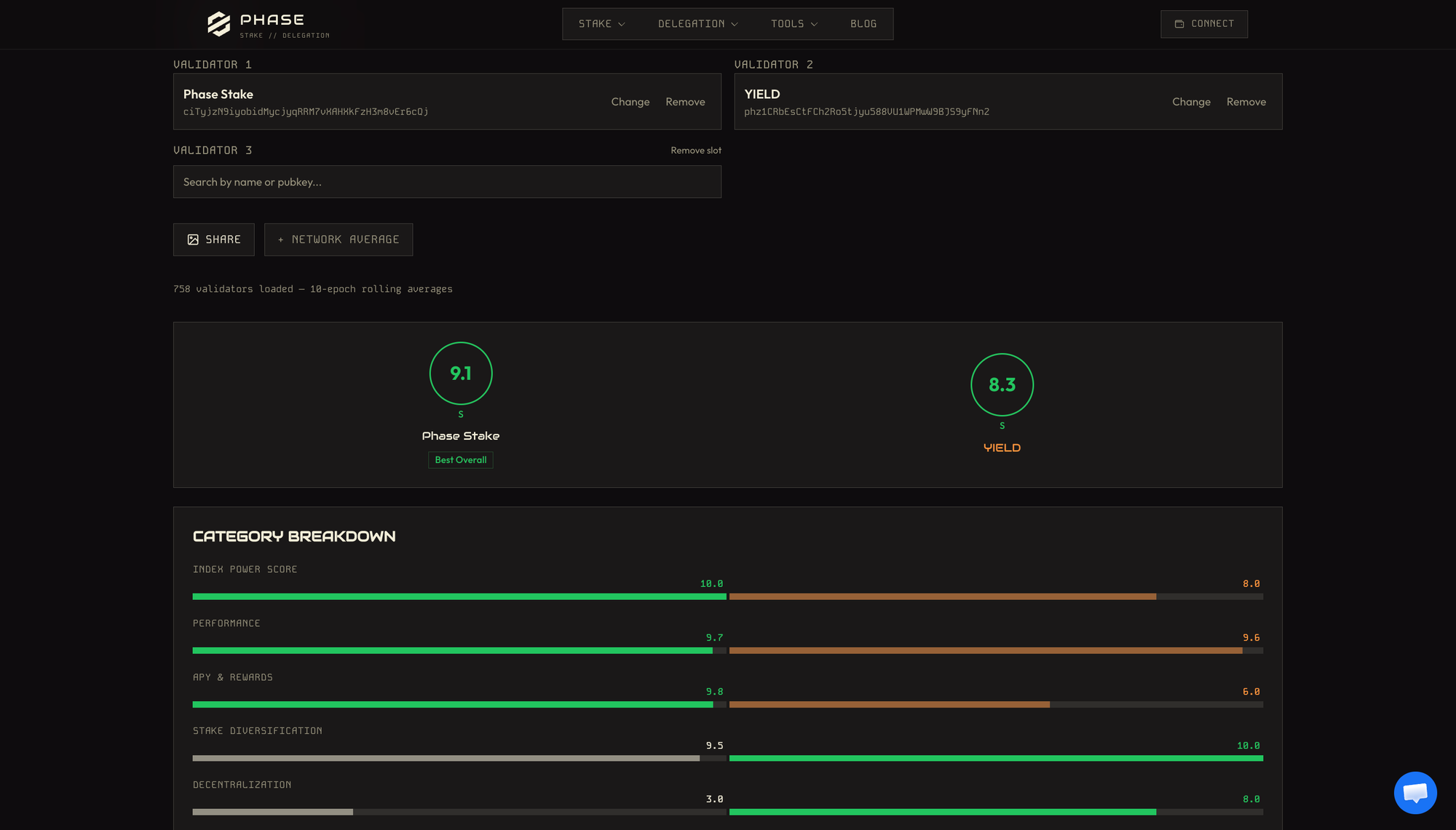
Stakers can also now evaluate this directly. Phase's Validator Comparison tool scores every active Solana validator on client diversity and infrastructure independence, alongside performance, APY, and stake diversification. The methodology is published, the data refreshes every five minutes from on-chain sources, and the underlying client and ASN for every validator are visible per profile.
How Phase thinks about client diversity
Phase Delegation includes Infrastructure Diversity as one of the four scored categories in the Index Power Score, weighted at 15%. The category covers both client software and ASN (network-level) diversity. Validators running diverse or current client software score better. Validators who stay on outdated versions or share infrastructure with the majority score worse.
This is one of the only delegation programs on Solana that directly ties stake allocation to infrastructure diversity. Most programs talk about network health in general terms. The IPS puts delegation behind it. Validators running Firedancer, maintaining current Agave versions, or operating on independent ASNs receive more stake from Phase Delegation than equivalent validators who do not.
In May 2026 we added ASN Diversity as a scored component, alongside Client Software. The reasoning: even if validators run diverse clients, if they all sit on the same network infrastructure, the network has the same concentration risk one layer down. Physical decentralization at the validator layer is downstream of decentralization at the infrastructure layer.
At 15%, Infrastructure Diversity is not the largest factor in a validator's score, but it compounds with the other three categories. A validator who contributes to infrastructure diversity while also scoring well on Contribution, Sustainability, and Partner alignment will consistently outperform one who ignores it.
The broader point is that network resilience is not someone else's problem. Validators choose which client to run. Delegators choose which validators to support. Programs like Phase Delegation choose how to weight those decisions. Each layer either reinforces the concentration pattern or pushes against it.
Solana's client landscape is more diverse than it was a year ago. It is not yet diverse enough. Getting there requires the economics to reward the operators who make the harder choice.
Learn more about Phase Delegation and the Index Power Score at https://phase.cc/delegation/ips.