How Do Solana Validators Get More Stake?

Running a healthy validator is the entry fee, not the strategy.
With around 730 validators competing and delegators able to check uptime, commission, and vote performance in seconds, the operators who grow are the ones treating stake as something you earn, channel by channel.
Here is every real path, and what each one actually requires.
Where does validator stake come from?
Four places: individual delegators choosing your validator directly, the Solana Foundation's delegation program, delegation programs run by stake pools and protocols, and stake attached to a liquid staking token you can issue with Phase. Most healthy validators build on two or three of these at once, because each has a ceiling and none is guaranteed to last.
Before any of them work, the baseline has to be in place: high uptime, competitive vote performance, a sane commission, and current software.
Delegators and programs alike screen these first. If the fundamentals are weak, nothing below applies.
How does community delegation actually happen?
Individual delegators pick validators for human reasons: they know who you are, they like what you do, or someone they trust pointed at you. That makes community delegation a visibility game as much as an operations game.
The validators that win it tend to do a few things consistently. They are public about who runs the operation and where. They contribute something beyond the validator itself: open-source tooling, research, education, community infrastructure. And they show up where delegators already are, ecosystem communities, X, governance discussions, rather than waiting to be discovered.
It is slow, and it compounds. A validator with a real identity accumulates delegators one conviction at a time, and that stake tends to be the stickiest kind, it chose you on purpose.
How does SFDP matching work now?
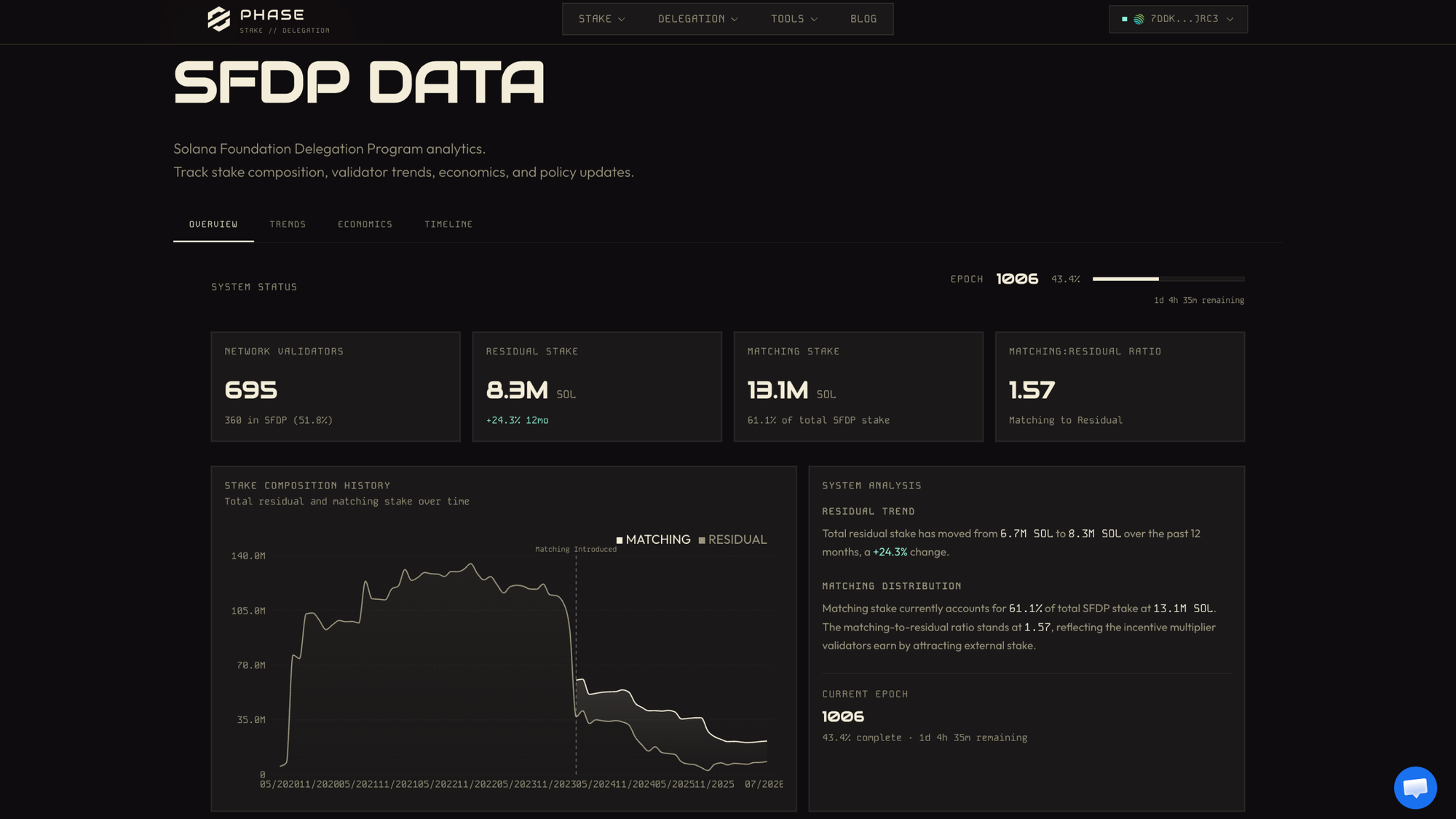
The Solana Foundation Delegation Program no longer hands out large baseline delegations. Since its October 2025 restructuring, the program functions as an incubator: it matches the external stake a validator attracts, currently at a 0.5:1 ratio with a 50,000 SOL cap, and it removes validators that fail to build outside support (three removed for each one onboarded, targeting validators eligible 18+ months with under 1,000 SOL of external stake).
The practical takeaway inverts how most operators think about it: SFDP is no longer a way to get stake instead of earning it, it is a multiplier on stake you earn elsewhere.
Every SOL of community or program delegation you attract is worth more because the Foundation matches part of it. Validators who treat SFDP as the strategy get offboarded; validators who treat it as a bonus on top of a real strategy get compounded.
What do delegation programs look for?
Delegation programs, run by stake pools, protocols, and staking companies, are the largest single lever most validators can pull, because one acceptance can mean thousands of SOL in delegation. Each program publishes (or at least applies) criteria, and they broadly screen for the same things: performance fundamentals, infrastructure choices, and increasingly, contribution to the network.
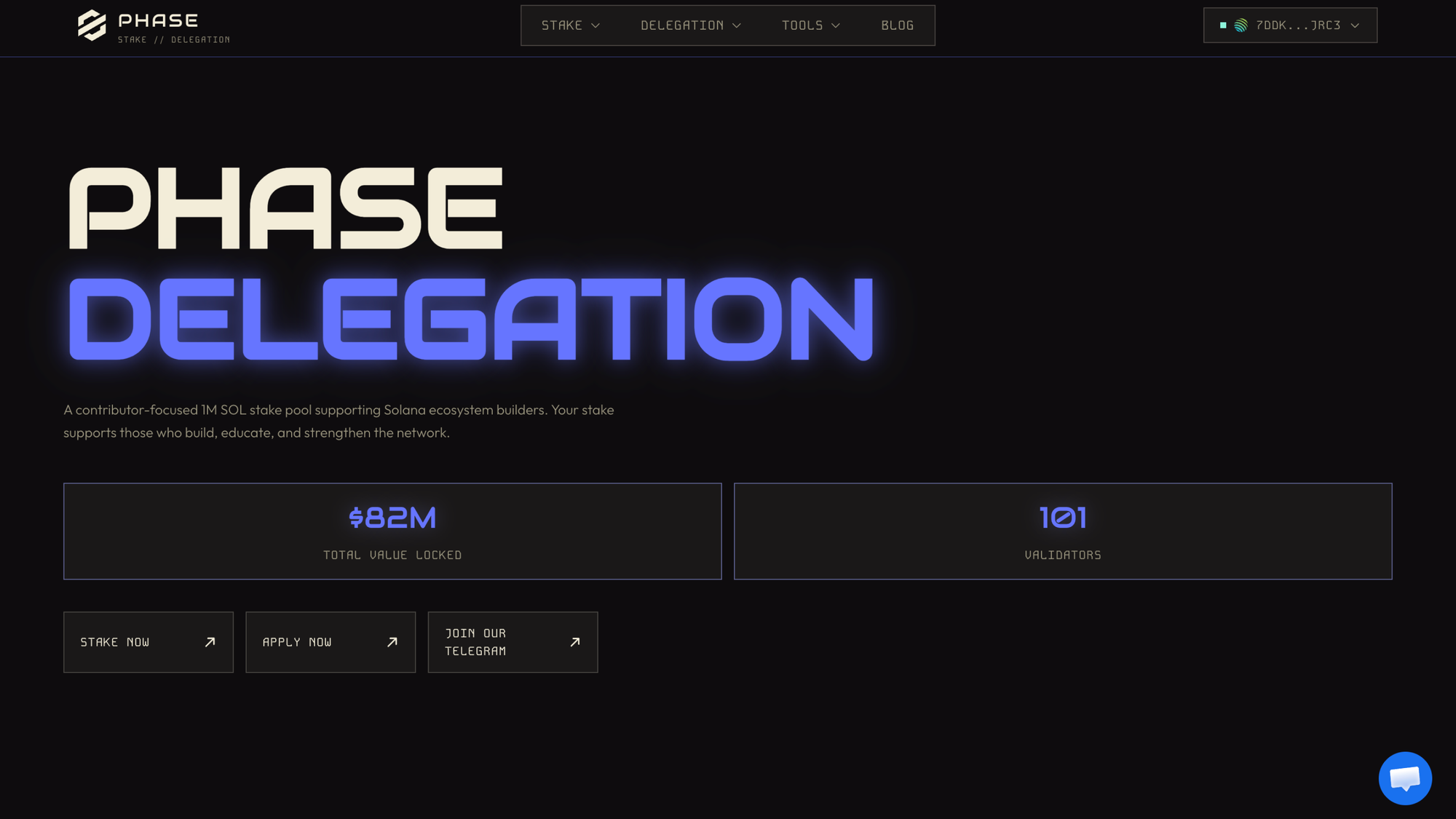
Phase Delegation is built entirely on that last idea. Its Index Power Score is a public framework that scores validators on ecosystem contribution with verifiable evidence, how much the delegation actually helps them sustain operations, infrastructure decisions that add client and geographic diversity, and completion of partner pillars like running DoubleZero Multicast. Stake follows the score across 100+ validators, and rebalances as scores change. The full scoring criteria are public, so a validator can read exactly what earns delegation before applying.
Other programs weight differently, some emphasize pure performance, some geography, some MEV configuration, but the direction across the ecosystem is the same: delegation is consolidating around operators who can demonstrate what they add to Solana, not just that they exist.
Should a validator launch its own LST?
A validator-branded liquid staking token turns your community into your stake. Holders mint the LST, the SOL stakes to your validator, and they hold a liquid receipt while you hold the delegation. Infrastructure providers have made this nearly turnkey, which is why community validators increasingly run one.
The honest caveat: an LST is a distribution product, not a magic spell. It works when a validator already has a community that wants to support it and just needs a low-friction way to do so. Without that demand, the token sits with no liquidity and adds operational surface for nothing. Build the community first; the LST converts it.
What actually separates validators that grow?
Every channel above pays for the same underlying thing.
Community delegators want a reason to pick you. SFDP multiplies what others already gave you. Delegation programs score what you contribute. An LST converts people who already believe in you.
The through-line is legibility: the validators that grow make it easy to verify what they do for Solana, economics in order, infrastructure choices that help the network, contributions someone can point to. The era of stake finding validators by accident is over. The operators treating that as good news are the ones the stake is flowing toward.
If you run a validator and contribute to Solana, Phase Delegation is open, and the criteria are public before you apply.